


6 July 2026
4D patches: the smart dressing that moves to help close wounds
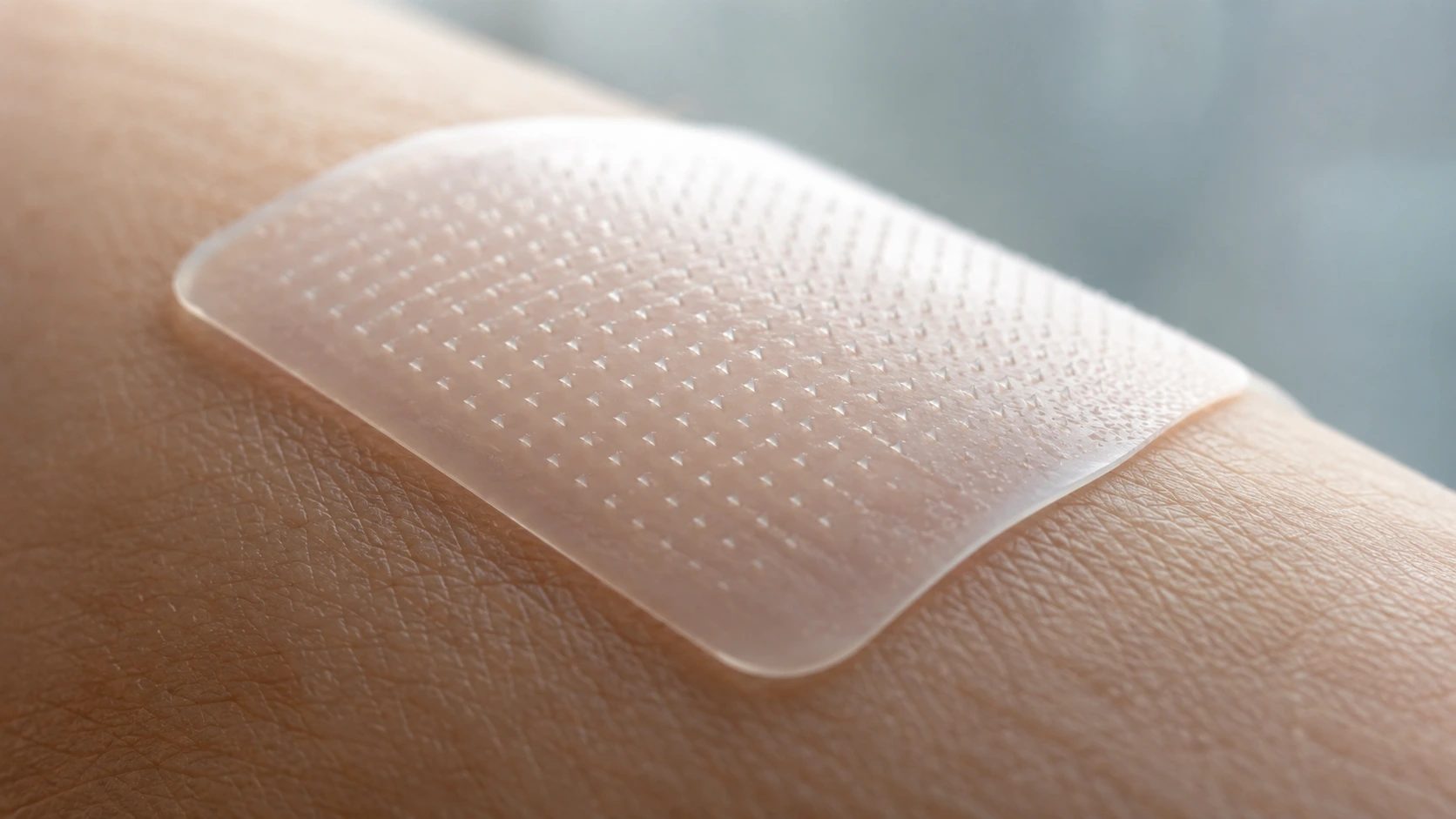
A patch usually seems to have a simple mechanism: it is placed on the skin, protects the damaged area and allows the body to do its work as it regenerates. But biomedical research is taking that concept much further. The new generation of smart materials is no longer limited to covering an injury. Some designs aim to interact with tissue, release substances in a controlled way, adapt to the biological environment and even change shape when they come into contact with the body.
That is the line of research followed by a team from Hanyang University, in South Korea, and published in Advanced Materials. The study presents a 4D-printed microneedle patch, designed with the help of artificial intelligence, that curves at body temperature to bring the edges of a wound closer together, maintain stable contact with the tissue and provide regenerative and antibacterial functions. The proposal focuses on a particularly complex problem: chronic diabetic wounds.
Wounds that do not always heal on their own
Diabetes does not only affect blood glucose. It can also alter circulation, the immune response and the body’s ability to repair tissue. That is why a small injury on the foot or another vulnerable area can progress slowly, become infected easily or turn into an ulcer that is difficult to close. The International Diabetes Federation estimates that 589 million adults are currently living with diabetes worldwide, a figure that helps show the scale of its health complications.
In this context, chronic wounds represent a clinical challenge because they do not always behave like acute injuries. Healthy skin activates a coordinated sequence: initial inflammation, arrival of repair cells, formation of new vessels, collagen production and reconstruction of the surface. In people with diabetes, this process can become blocked by persistent inflammation, oxidative stress, reduced formation of blood vessels, neuropathy and infection. The result is not only slower healing, but also greater exposure to relapses and serious complications.
Microneedles that act from within
The innovation of the 4D patch lies in combining several responses within a single system. The microneedles minimally penetrate the superficial layer of the skin and allow direct action on the wound microenvironment. They are not conventional needles and are not designed for deep puncture. Their value lies in opening microchannels, improving contact with the tissue and serving as a platform to deliver therapeutic components locally.
The idea of “4D” may sound abstract, but it is easier to understand when compared with 3D printing. In 3D printing, a structure with volume is created. In 4D printing, that structure incorporates an additional ability: to change over time in response to an external stimulus, such as temperature, humidity, light or pH. In this case, the key stimulus is physiological temperature, around 37 ºC. When it comes into contact with the body, the microneedles recover a programmed shape and curve.
Inspiration taken from nature
The design was inspired by Drosera capensis, a carnivorous plant capable of trapping prey through movement, adhesion and defence mechanisms. The researchers transferred that logic to a biomedical device: microstructures that do not remain rigid and inert, but bend to improve physical closure and adhesion to the injured area. In this case, biomimicry is not about copying an attractive feature from nature, but about turning a biological behaviour into a useful function for medicine.
Artificial intelligence enters a less visible but equally important part of this research: the design of the material. The team used models capable of analysing different combinations and predicting which ones could work best before manufacturing them in the laboratory. This allowed them to adjust the composition of the patch so that the microneedles were stable enough, but also able to curve quickly when they came into contact with body temperature. In other words, AI helped shorten the path between the initial idea and a design with a better chance of working.
More than covering an injury
The patch also incorporates a layer designed for regeneration and bacterial control. According to information published by Hanyang University, the system integrates adhesive DNA nanoparticles aimed at supporting tissue repair and a zinc-treated surface to provide antibacterial protection. In laboratory tests, the patch showed three interesting effects: it released its components gradually, supported the activity of cells involved in skin repair and helped slow down bacteria commonly found in wound infections.
Put simply, it did not just cover the injury; it seemed to help create a more favourable environment for the tissue to recover. This combination fits within a growing trend in biomedical engineering: developing devices that are not simple supports, but multifunctional platforms capable of acting on several obstacles at once.
A promising advance, but still preclinical
Even so, caution is necessary. The research is at a preclinical stage, and the statement itself notes that more studies are needed before considering its clinical use. This means we are not talking about a patch already available in hospitals or an immediate solution for patients. Essential aspects still need to be evaluated, including safety, effectiveness in humans, product stability, health regulation, cost and comparison with treatments already used in wound care units.
But that caution does not reduce the value of the research. The interest of this type of work lies in showing where regenerative medicine is heading: materials that respond to the body, data-designed devices, more precise local therapies and increasing integration between biology, engineering, nanotechnology and artificial intelligence. For complex wounds, this approach could open research lines that are more personalised and better adapted to the real behaviour of each injury.
Health innovation also comes from engineering
It also raises an educational point. The healthcare of the future will not be understood from a single discipline. A patch like this requires knowledge of physiology, microbiology, materials science, programming, advanced manufacturing, experimental design and clinical evaluation. Healthcare innovation does not appear only in operating rooms or pharmacological laboratories; it also emerges at the meeting point between teams capable of translating a medical problem into a viable technical solution.
4D patches do not replace professional monitoring or the comprehensive management of diabetic wounds. Glycaemic control, foot checks, pressure offloading, early detection of infections and multidisciplinary care remain essential pillars. Technology can provide new tools, but healthcare still depends on well-coordinated clinical decisions.
Another way to imagine a dressing
What makes this advance relevant is that it changes the way we imagine a dressing. No longer as a passive surface placed on the skin, but as a programmed material designed to respond, move and participate in repair. There is still a distance to cover before clinical practice, but the direction is clear: regenerative medicine is moving towards more intelligent, more specific devices that are better adapted to the real complexity of the human body.

