


14 July 2026
A Sea Anemone Reveals Another Way to Fight Viruses
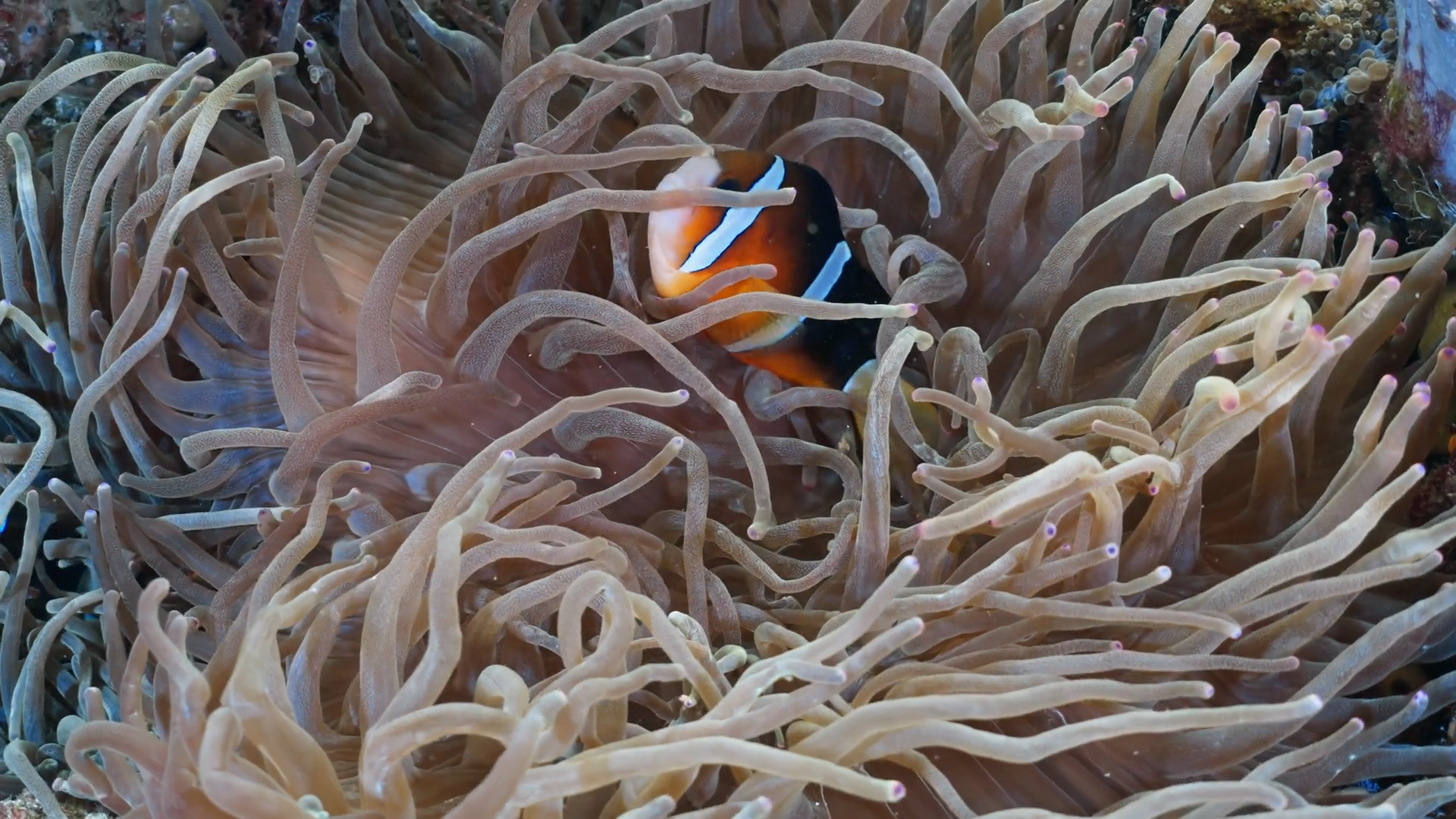
A sea anemone does not have an immune system like ours, but it has spent millions of years exposed to viruses and other microorganisms. It therefore also needs to recognise them, prevent them from multiplying and limit their spread. Studying how it achieves this can reveal biological solutions that emerged long before vertebrates appeared.
That is what an international team has done with Nematostella vectensis, a small sea anemone frequently used in scientific research. The study, published in Nature Ecology & Evolution, identified a previously unknown protein involved in its defence against viruses. The researchers named it CARDIB, and its behaviour proved striking: it resembles a protein that activates the antiviral alarm in vertebrates, but in the anemone, it initially acts as a brake.
The finding points to a fairly complex possibility: animals may not have developed a single way of confronting viruses. Throughout evolution, different systems may have emerged, built from components that are similar but not identical, to detect an infection and determine when to respond.
When a virus enters a cell, it leaves behind signals that can reveal its presence. One of them is its genetic material, which certain cellular sensors can recognise. This detection triggers a chain of internal messages and activates genes designed to limit the infection, prevent the virus from continuing to multiply or eliminate compromised cells.
In humans and other vertebrates, a protein called MAVS plays an important role in this process. It receives the signal from the sensors and helps activate the antiviral response. Researchers found a somewhat similar protein in Nematostella and expected it to perform a comparable task, although the experiments revealed that it worked differently.
CARDIB binds to one of the anemone’s viral sensors and, while no threat is present, keeps several immunity-related genes switched off. This function makes sense: a permanently active defence response would consume energy and could harm the organism itself. The system needs to remain prepared, while also avoiding false alarms.
The surprising result came when the researchers removed CARDIB. If its only role were to restrain the defences, its absence should have allowed a stronger protective response. The opposite happened. Without this protein, the anemone could no longer correctly activate its antiviral genes when a threat appeared.
CARDIB therefore participates in two essential stages: it helps keep the system at rest and is also necessary for it to respond. The study does not yet explain every step involved in moving from one state to the other, but it does show that the brake forms part of the response mechanism itself.
To examine its function, the researchers used CRISPR gene editing to create anemones without the gene that produces CARDIB. They also modified the sensor with which the protein interacts and compared the results with animals whose immune system remained intact.
When exposed to a viral signal, the modified anemones were barely able to activate the expected response. Programmed cell death was also disrupted, even though it is a process that can help contain an infection. When a virus uses a cell to produce new copies of itself, eliminating that cell makes it harder for the invader to continue spreading.
The effect was ultimately reflected in the amount of virus detected. Animals without CARDIB or its associated sensor accumulated a higher viral load than normal anemones. Losing a protein that restrained immune activity had left the organism more exposed rather than better protected.
The result confirms that CARDIB does not work as a simple switch. It forms part of a system that must balance two needs: avoiding an unnecessary reaction and responding effectively when a threat is actually present.
Controlled experiments allow researchers to observe each mechanism precisely, but the natural environment is far more complex. In the sea, anemones coexist with numerous viruses, bacteria and other microorganisms, as well as constant changes in the water. To recreate these conditions more closely, part of the study took place in experimental facilities in South Carolina supplied with natural water from an estuary. Scientists placed normal and genetically modified anemones in the systems and then analysed which viruses had accumulated in each group.
Anemones with alterations in CARDIB and their viral sensors showed a greater presence of viruses. Some defences also revealed their full importance only when the animals encountered a real community of microorganisms. One sensor that had appeared to play a limited role in the laboratory became more important in this diverse environment.
The test confirmed that CARDIB was not involved only in an artificially induced reaction. It formed part of the anemone’s everyday ability to coexist with the viruses in its habitat and keep them under control.
Nematostella belongs to the cnidarians, a group that also includes corals and jellyfish. Its evolutionary lineage separated from the one that gave rise to humans hundreds of millions of years ago. Comparing the two systems allows researchers to investigate how antiviral defences emerged and how they have changed over time.
CARDIB shares some characteristics with MAVS, but the two proteins do not perform the same function. In vertebrates, MAVS helps transmit the signal that activates a defence response. In the anemone, CARDIB initially keeps certain genes under control, yet it is also essential for their later activation. Evolution has used similar components within different biological circuits.
The finding also shows that similarities between genes or proteins are not enough to assume that they work in the same way in every animal. Two components may retain part of the same structure while occupying different positions within the system.
For now, the research belongs to the field of evolutionary biology and does not propose a new antiviral treatment for humans. Its main contribution is to expand the range of defensive strategies found in nature. Understanding how other animals regulate their defences may reveal principles that would remain unnoticed if research focused exclusively on humans or the most commonly used laboratory models.
Slug: when-holding-back-means-defending-sea-anemone-discovery
Chip: Evolutionary Biology

