


16 April 2026
From the first cured patient to the latest breakthroughs: how the fight against HIV is evolving
In April 2026, Nature Microbiology published the tenth confirmed case of HIV remission: a 62-year-old Norwegian patient who has been off antiretroviral therapy (ART) for four years with no detectable virus. This is not a miracle. It is the result of nearly two decades of accumulated scientific progress since a Berlin physician made an unorthodox decision in 2007.
These ten cases do not represent a cure available to most people. However, they provide the strongest biological proof to date that the human immune system can function without HIV. And that changes everything for research.
“Cured” and “in remission” are not the same
This distinction is essential, as it is often blurred in media coverage.
Antiretroviral therapy (ART) suppresses the virus to undetectable levels and enables a near-normal life, but it requires lifelong daily treatment. It does not eliminate the virus; it controls it.
The ten documented cases are qualitatively different: these individuals discontinued treatment under medical supervision, and the virus did not rebound. The scientific community refers to this as sustained functional remission, rather than sterilizing cure, since latent viral reservoirs (infected cells that remain inactive for years and are not reached by current therapies) cannot be completely ruled out.
This distinction is critical. These cases demonstrate that remission is biologically possible, even if it cannot yet be reproduced safely and at scale.
The ten cases: what they have in common
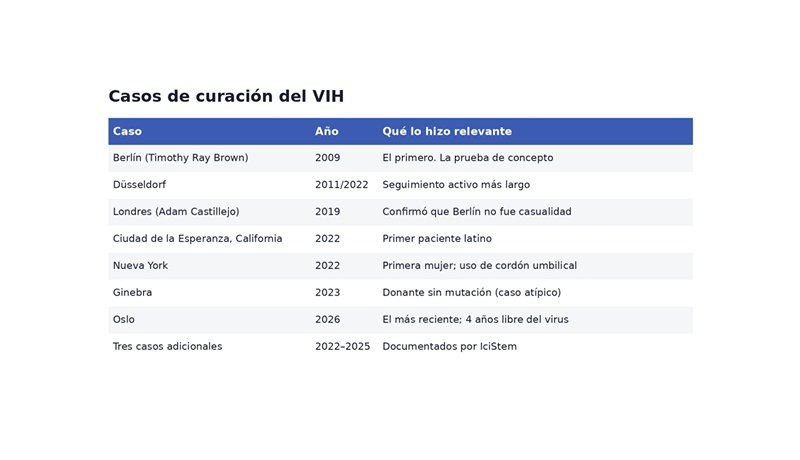
All patients underwent a stem cell or bone marrow transplant to treat a hematologic cancer (leukemia or lymphoma), and most received cells from donors carrying the CCR5-Δ32 mutation.
Their follow-up is coordinated by the international consortium IciStem, led by researchers Javier Martínez-Picado and María Salgado at IrsiCaixa (Barcelona). The consortium monitors more than 70 HIV-positive transplant recipients worldwide. Only ten have achieved sustained remission.
The starting point: Timothy Ray Brown
In 2007, Timothy Ray Brown had leukemia and had been living with HIV for twelve years. His hematologist at Berlin’s Charité Hospital, Dr. Gero Hütter, sought a bone marrow donor carrying the CCR5-Δ32 mutation.
The transplant was successful in treating the cancer. What was unexpected was that HIV also disappeared.
The case, published in The New England Journal of Medicine in 2009, took weeks to be fully accepted by the scientific community. Brown lived virus-free for more than twelve years. He died in 2020 due to leukemia relapse, not HIV, and remained actively involved in research until the end. His case paved the way for the nine that followed.
The most recent: the Oslo patient
The tenth case, published in Nature Microbiology in April 2026 by the IciStem consortium, involves a 62-year-old Norwegian patient who received a stem cell transplant for lymphoma and has now remained off treatment with a sustained undetectable viral load for four years.
As Martínez-Picado noted: “At first, it was said that a cure was impossible, that the Berlin patient was a fluke. But ten patients later, we know it is possible to cure HIV infection. The challenge now is to make it scalable.”
The molecular key: why the CCR5-Δ32 mutation works
HIV requires the CCR5 receptor to enter immune cells. The CCR5-Δ32 mutation effectively removes this entry point: individuals who inherit it from both parents have cells that are highly resistant to infection.
However, this mutation is rare, present in only about ~1% of the Northern European population, which has historically made it difficult to find compatible donors for patients from other backgrounds.
The New York case (2022) marked a turning point. By using umbilical cord blood, which allows for greater donor diversity, remission was achieved in a patient of mixed ancestry.
The Geneva case raises further questions: the donor did not carry the mutation. This suggests that alternative mechanisms of remission may exist and are now a key focus of ongoing research.
Why this approach is not widely applicable (yet)
Bone marrow transplantation carries a mortality rate of 10–30% within the first 100 days. It is only performed when a severe hematologic cancer justifies that level of risk.
For individuals with well-controlled HIV on ART, this approach would be unjustifiable, as standard treatment is safe, well tolerated, and provides a life expectancy close to that of the general population.
These cases do not represent a scalable treatment today. Instead, they demonstrate something more fundamental: that remission is biologically achievable.
The three most promising lines of research
Gene editing with CRISPR.
If protection comes from the absence of the CCR5 receptor, could it be removed directly from a patient’s cells without transplantation? CRISPR aims to do exactly that—editing specific genes with unprecedented precision. Clinical trials, including those led by Carl June at the University of Pennsylvania, show that the approach is safe and that modified cells can persist. The key challenge is achieving sufficient numbers of edited cells to ensure long-term protection.Therapeutic vaccines.
Unlike preventive vaccines, these aim to train the immune system of people living with HIV to control the virus without medication. mRNA technology, successfully used in COVID-19 vaccines, is now being applied to HIV. A 2024 study published in The Lancet showed delayed viral rebound after treatment interruption in some patients, indicating a measurable immune response.“Shock and kill.”
HIV persists by hiding in dormant immune cells. This strategy seeks to first “activate” these latent reservoirs and then eliminate them before viral replication resumes. While the activation phase has shown promise, eliminating the infected cells remains a challenge. Current research focuses on combining this strategy with vaccines or antibodies that enhance immune clearance.
Conclusion
Ten individuals. All underwent cancer treatment, high-risk transplants, and in most cases received cells from donors with a rare genetic mutation. This is not a broadly applicable pathway.
However, these cases demonstrate that HIV can functionally disappear from the human body—and that insight has reshaped decades of research.
The question is no longer whether it is possible, but how to make it accessible.
That answer is being developed by multidisciplinary teams across more than fifteen countries, at the intersection of hematology, virology, genetics, and immunology.
At MUNDAE, we train professionals to operate at that frontier.

