


7 May 2026
Sixty billion losses a day (and they all happen inside you)
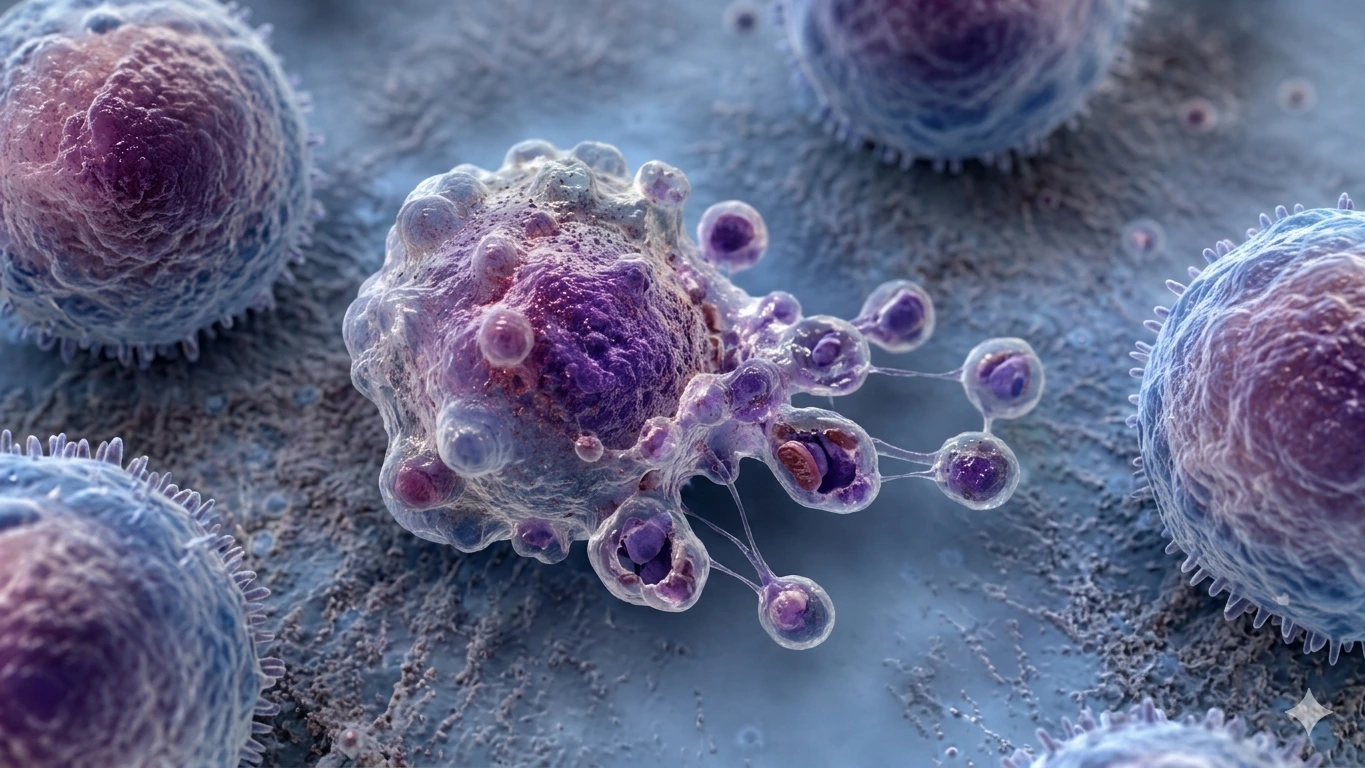
As you read this sentence, tens of thousands of cells in your body are quietly switching off.
This is not a metaphor. Every day, between 50 and 70 billion of your own cells receive an internal order, "it is your turn", and silently dismantle themselves. In roughly two years, that renewal can amount to a cell mass comparable to the weight of an adult body, removed and replaced without you noticing.
That mechanism has a name, and it is one of the most elegant in biology: apoptosis.
The word comes from the Greek apóptōsis, "falling off", the same term ancient Greeks used to describe leaves detaching from a tree in autumn or petals falling from a flower. When pathologists John Kerr, Andrew Wyllie and Alastair Currie coined the term in 1972, they deliberately chose that image. It is not destruction. It is detachment.
Disappearing without “breaking anything”
To understand why apoptosis was such a revolutionary idea, it helps to compare it with its opposite: necrosis. When a cell dies because of trauma, an aggressive infection or lack of oxygen, it does so messily. It swells, bursts, spills its contents and triggers inflammation in the surrounding tissue. It is the cellular equivalent of an accident.
Apoptosis is the opposite. The cell shrinks, fragments its DNA in an orderly way and breaks into small membrane-wrapped packages. Other cells in the body —mainly macrophages— collect and recycle them without anyone nearby noticing. It is a farewell with instructions. A death that does not disturb the neighbours.
One millimetre of science
The fact that we understand apoptosis in such detail is largely thanks to an animal the size of a pinhead: Caenorhabditis elegans, a transparent worm just one millimetre long.
In the 1970s, a team of biologists in Cambridge realised that this worm was ideal for studying development: it had few cells, a short life span and made it possible to see everything happening inside. They decided to take on a seemingly impossible task: tracking, one by one, every cell in the animal from embryo to adult.
And they succeeded. In doing so, they found a surprising pattern: of the 1,090 cells produced by the worm, exactly 131 always die. The same cells, in the same order, in every individual. Death was not random: it was written in the manual.
The next question was who gave the order. When the responsible genes were identified, some ordering death, others preventing it, and the entire development of the animal depending on their balance, it became clear that those same genes, with small variations, also exist in us. That work, carried out by Sydney Brenner, John Sulston and Robert Horvitz, received the Nobel Prize in Medicine in 2002 and opened up an entire field of research.
What is built by disappearing
Apoptosis is not only a maintenance tool: it also sculpts.
A human embryo does not make fingers separately, but rather a small paddle with tissue between them. What separates the fingers is not that they grow apart, but that the cells in the spaces between them receive the order to die. Without that cellular withdrawal, fingers would not finish separating in the way we know them.
The tadpole takes that same logic to the extreme. When it transforms into a frog, developing legs is not enough: it has to lose its tail. And it loses it because every cell in that tail, row by row, activates its death programme until the entire tissue has disappeared. Metamorphosis is, in part, a choreographed disappearance.
The cellular sacrifice against viruses
Here is an idea that rarely appears in articles about apoptosis and that changes the perspective quite a lot: your defence against viruses depends, to a large extent, on convincing your own cells to self-destruct.
When a virus, the flu virus, for example, infects a cell, it turns it into a copy-making factory for itself. The most effective way to stop it is not to attack the virus directly, but to eliminate the factory. Cytotoxic T lymphocytes in the immune system do exactly that: they recognise infected cells and induce apoptosis in them. The cell dies, the virus loses its copy factory and the damage remains far more controlled.
In other words: your immunity does not work only by destroying invaders. It also works by persuading your own cells that their time has come.
Escaping control
And then we arrive at cancer.
A healthy cell carries several control systems within it. If its DNA is seriously damaged, it must repair it or, if the damage is irreversible, enter apoptosis. It is a basic safety mechanism: a broken cell should not keep dividing.
The problem begins when that system fails. Tumour cells, among many other abnormalities, often learn to disable apoptosis. They survive when they should withdraw, divide uncontrollably and accumulate more errors with each generation. That is why biologists consider "evading cell death" one of the defining hallmarks of cancer.
The good news is that this weakness is also a target. A new generation of cancer drugs, such as venetoclax, used in certain haematological cancers, works by blocking the proteins that help tumour cells resist death. The cell finally receives the order it has been ignoring, and switches off.
Some of the most advanced cancer medicine consists, quite literally, of teaching a cell to die.
Invisible balance
Let us return to the beginning. Sixty billion cells a day. A figure so large that it almost loses meaning, until you understand what it implies: your body is not sustained only by adding, but by precisely regulating when to remove. What we call "being healthy" is, to a large extent, maintaining that balance.
Apoptosis happens while you have breakfast, while you sleep, while you read this. You do not notice it because it is designed to go unnoticed. And yet, without it, you would not have separated fingers, functional immunity, or protection against cancer.
And perhaps that is one of biology’s great lessons: not everything that disappears stops serving a purpose.

