


27 May 2026
Baby teeth: a biological memory of the early years
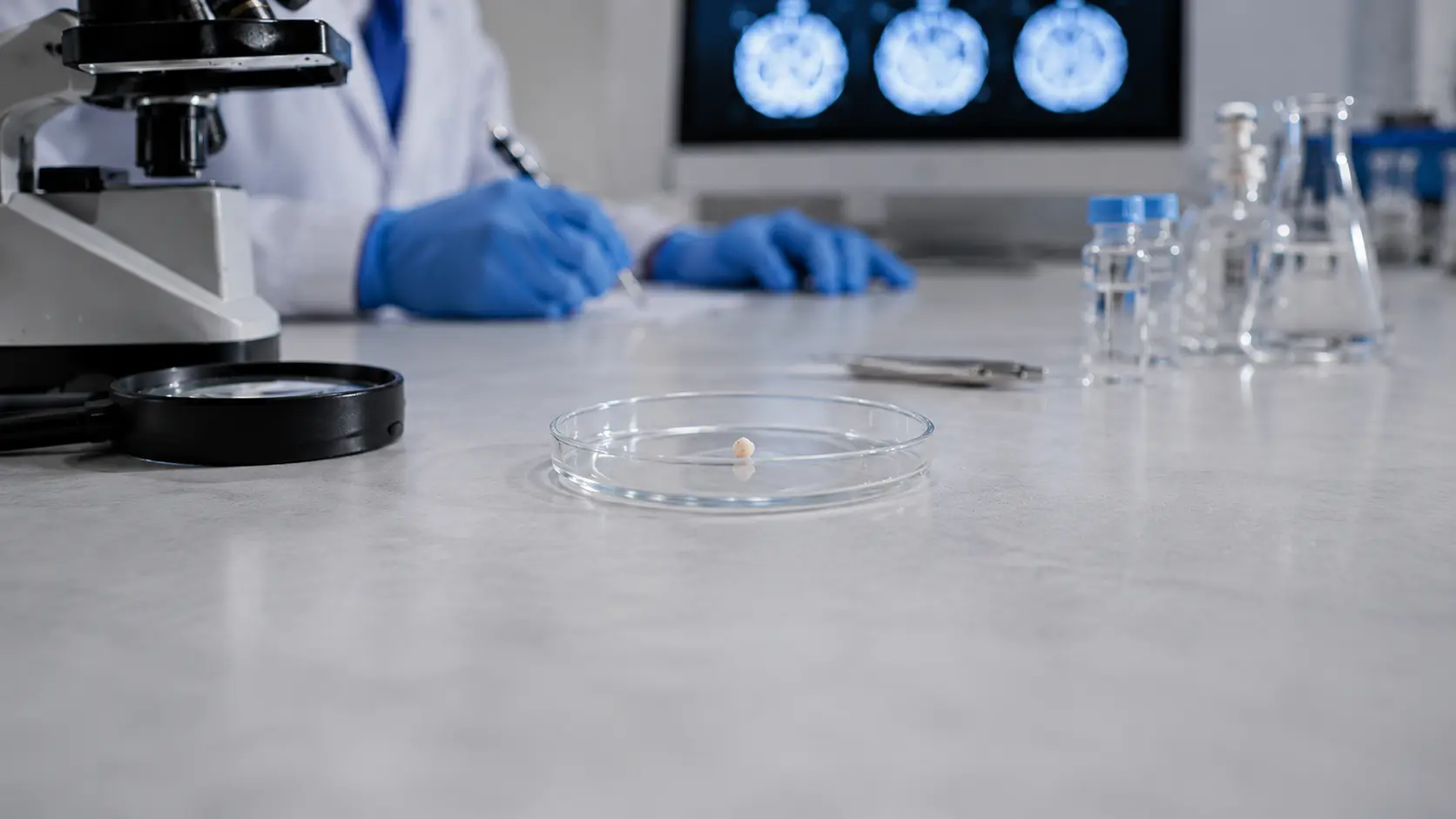
From the family drawer to the laboratory: what primary teeth can reveal about brain development, the environment and child health prevention.
A baby tooth usually belongs to the realm of everyday life: a small tooth that starts to wobble, an expected fall, a family that keeps it or a tooth fairy that exchanges it for a coin. For biomedical research, however, that same tooth is beginning to occupy a much more interesting place.
The reason lies in how it grows. Primary teeth do not appear all at once: they develop progressively from the fetal stage and during the first years of life. As they form, enamel and dentin leave microscopic growth marks, similar to the rings of a tree, where small amounts of substances from the environment can become trapped. Today, laboratory techniques make it possible to read those marks layer by layer and reconstruct, with considerable precision, what an organism was exposed to during each stage of its development.
A window into a stage that is difficult to measure
In child health, many important exposures occur before their consequences can be observed. During pregnancy and the first months of life, the body builds essential systems such as the nervous system, metabolism, immunity and the stress response, making those months a period of great plasticity and, at the same time, particular vulnerability.
Reconstructing what happened during that period is complicated. Family surveys depend on memory, while blood or urine tests reflect a single moment in time. Baby teeth, however, allow something different: they make it possible to estimate not only whether there was exposure to certain elements, but approximately when it occurred. And that nuance is decisive, because in neurodevelopment, the timing of an exposure can be just as relevant as its intensity.
The Mount Sinai study
In April 2026, Science Advances published a study by the Icahn School of Medicine at Mount Sinai that once again placed this topic at the centre of scientific discussion. The team analysed naturally shed baby teeth to study early exposure to mixtures of metals and their possible relationship with brain development and behaviour years later.
The research combined dental data, behavioural assessments and brain magnetic resonance imaging: 489 children with tooth-derived data, 395 behavioural assessments and 191 MRI scans. From the teeth, weekly exposures to nine metals were reconstructed from the second trimester of pregnancy to the first year of life. It is worth remembering that this type of panel includes both elements that are essential for the body, such as zinc or manganese, and others with known risks for neurodevelopment, such as lead. In real life, people are not exposed to a single isolated metal, but to mixtures present in water, food or the environment.
Two especially sensitive windows appeared after birth: weeks 4 to 8 and weeks 32 to 42. During those periods, higher exposure to mixtures of metals was associated with more later signs of anxiety, attention difficulties and mood alterations, as well as observable changes in brain development and connectivity between regions.
These findings should be read with caution. This is an observational study, in which it is difficult to rule out the influence of other factors, and it needs to be replicated in larger and more diverse populations. It does not mean that a tooth can predict a child’s future, nor that a specific exposure alone determines a mental health problem. What it does suggest is that certain moments in development appear to be more permeable to the environment than others.
The neonatal line
One of the most striking elements in the study of primary teeth is the so-called neonatal line: a microscopic mark visible in the enamel and dentin of primary teeth, associated with the moment of birth. It functions as a biological boundary between two worlds that, from the outside, may seem continuous, but represent a radical change for the organism: the intrauterine environment and life after birth, with autonomous breathing, feeding and metabolic adaptation to the outside world. That mark turns the tooth into an imperfect but useful chronology.
Research, not diagnosis
The possibility of reading a baby tooth can immediately raise questions for any family with children: should every tooth be kept for medical reasons? Could it be analysed in a laboratory? For now, no. These studies belong to the field of specific population-based research, not individual diagnosis. Teeth kept at home have sentimental value, but no current clinical use.
Their value lies elsewhere. If science manages to identify moments in development that are especially sensitive to environmental conditions, public health strategies can become more precise: better protecting pregnancy, reducing avoidable exposures, monitoring the quality of water and certain pollutants and strengthening child follow-up. Seen this way, prevention does not begin when a symptom appears, but much earlier, in the conditions that favour or hinder healthy development.
A perspective that also changes how professionals are trained
This way of understanding health, multidisciplinary and prevention-oriented, raises a parallel question: how professionals are trained. When relevant findings emerge from the intersection of very different disciplines, areas such as paediatrics, nursing, psychology or public health stop being isolated compartments and need to communicate with one another.
It is precisely this intersection between science, clinical practice and a population-based perspective that guides educational projects such as that of Universidad Internacional Mundae, focused on health sciences and built around the student’s early contact with hospitals, clinics and research environments. Learning in this way, through action and within a real-world context, is consistent with an idea of health that follows symptoms less and anticipates them more. For many families, primary teeth will continue to be a symbol of childhood. But in the laboratory and in the classrooms training the next generation of healthcare professionals, they are proving to be something more: a biological sample capable of preserving information about a stage that used to remain beyond the reach of study.

