


August
1,622 patients treated in three days: how Ceuta’s healthcare system responded
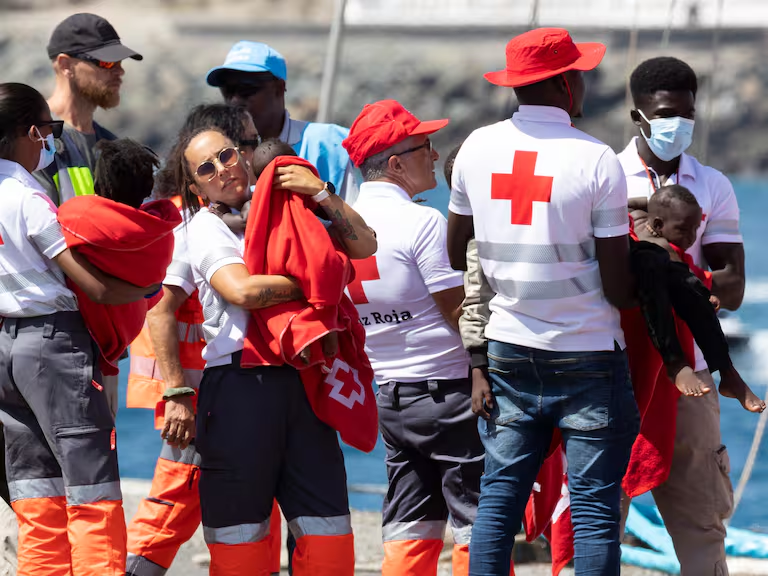
Image: Quique Curbelo / EFE
A healthcare network is organised and designed to meet the usual needs of its population: it calculates how many professionals are required, distributes ambulances, reserves hospital beds, and maintains stocks of medicines and supplies. But what happens when an unexpected situation suddenly changes the demand for healthcare services? The arrival of thousands of people can disrupt that balance within hours. In Ceuta, healthcare services recorded 1,622 attendances between 31 July and 2 August 2026. Although the system did not collapse, Primary Care, hospital emergency departments, and the 061 emergency service had to be reinforced to respond to the extraordinary increase in demand.
Situations like this reveal a less visible part of healthcare: its ability to adapt when needs become unpredictable. The challenge does not depend solely on the total number of patients, but also on how many arrive at the same time, the severity of their condition, and the resources available. A system may be able to treat hundreds of people over several weeks but become seriously strained if many require assessment during the same afternoon.
The first difficulty is that not everyone has the same healthcare needs. Some people may require wound care, hydration, food, or access to their regular medication. Others arrive with injuries, trauma, breathing problems, exhaustion, or hypothermia, as well as complications caused by spending hours in difficult conditions. There may also be pregnant women, children, and patients with chronic illnesses whose treatments have been interrupted. For this reason, the response cannot simply involve taking everyone to hospital and treating them in order of arrival.
This is where triage comes into play: a rapid assessment used to organise care according to the level of urgency. Professionals examine breathing, circulation, consciousness, and injuries, along with other signs that indicate whether someone needs immediate assistance or can wait safely. Priority is not determined by who arrived first, but by the risk to their life and the likelihood that their condition may worsen. This classification must also be reviewed, because someone who initially appeared stable may deteriorate over time.
Once this initial assessment has been completed, professionals must decide where each patient should be treated. Not everyone needs to be admitted to hospital. Primary care centres can treat minor problems, provide wound care, and administer medication, while identifying those who require more complex tests. Emergency teams provide care at the scene, stabilise patients, and arrange transfers. Hospitals are reserved for those who need surgery, intensive care, continuous monitoring, or specialist treatment.
This distribution is essential to prevent all demand from becoming concentrated in hospital emergency departments. According to one of Ceuta’s initial reports, 902 of the 1,149 attendances recorded at that point had been managed in Primary Care, while 247 were treated at the University Hospital. Most people were able to receive care without entering the hospital system, preserving beds, diagnostic services, and specialist staff for the most serious cases.
Increasing hospital capacity does not simply mean making more beds available. Each bed requires professionals, oxygen, monitoring equipment, supplies, medication, and access to diagnostic tests. It is also necessary to guarantee the operation of radiology, laboratories, pharmacies, operating theatres, and blood banks, as well as intensive care units. If any of these services becomes overwhelmed, treatment may be delayed, even when physical spaces remain available.
Nursing professionals occupy a central position throughout this process. They participate in the initial assessment, monitor vital signs, administer medication, provide wound care, and observe each patient’s progress, while also detecting changes that may indicate deterioration. When the number of patients rises, these tasks must be carried out quickly, but without losing accuracy.
Another difficulty arises when clinical information is unavailable. Some people may arrive without identification, medical reports, or precise information about the treatments they normally receive. Combined with language barriers, this can make it more difficult to explain symptoms, medical history, pregnancies, or allergies. These situations require clear questions, reliable identification systems, and language support. Essential information should accompany the patient during every transfer so that teams do not have to repeat the assessment from the beginning.
Age and personal circumstances also affect clinical priorities. A child may become dehydrated more quickly than an adult and may not be able to explain what is wrong. A pregnant woman may require a more extensive obstetric assessment, even when the initial concern appears minor. Situations such as these, together with the emotional impact of an extreme experience, can lead to fear, disorientation, distress, or difficulties communicating.
The challenge becomes greater because, while this extraordinary demand is being managed, routine healthcare activity does not disappear. Heart attacks, births, accidents, infections, and complications of existing illnesses continue to occur. There are also scheduled treatments and follow-up appointments that cannot be postponed indefinitely. One of the greatest challenges is responding to the emergency without leaving the local population without care.
To achieve this, the system needs to reinforce shifts, redistribute professionals, and expand certain points of care, while creating temporary services for less serious cases. This ability to increase resources quickly is known as surge capacity. It does not depend solely on having supplies in storage, but also on having a plan that establishes who leads the response, which spaces can be used, and which professionals should be brought in, as well as how additional supplies should be requested.
Staff rotation is also essential. During the first few hours, the situation may be managed through immediate reinforcements and the extension of certain shifts. If the pressure continues, fatigue can affect concentration, decision-making, and patient safety, so the organisation must provide breaks, replacements, and sufficient teams to maintain care over several days.
Coordination between the different levels of the healthcare system is equally important. Primary Care, the hospital, the 061 emergency service, and support services need to share information about available beds, supplies, transfers, and patient numbers. If each team operates separately, unnecessary concentrations of patients may occur in some locations while others retain capacity. Shared communication makes it possible to distribute the workload more effectively and adapt the response as the situation changes.
Care does not end when the number of arrivals begins to fall. Patients may later require follow-up care, replacement medication, vaccination, wound monitoring, maternal and child healthcare, or emotional support. At the same time, healthcare centres must gradually restore their normal activity, replenish supplies, and review what happened. Analysing waiting times, transfers, and the difficulties encountered helps improve protocols for future emergencies.
The case of Ceuta demonstrates the importance of managing exceptional pressure on healthcare services so that it does not necessarily result in collapse. This can be achieved when care is distributed, resources are reinforced, and different teams work in coordination. When demand increases within a few hours, the response depends both on clinical work and on less visible decisions: classifying patients, protecting hospital capacity, sharing information, and maintaining routine care. The difference lies not only in the number of resources available, but also in the speed and judgement with which they are put into operation.

