


18 August 2026
Drowning Doesn’t Look Like It Does in the Movies: Signs and Measures That Can Save a Life
When we see a drowning scene in a film or TV series, it is usually portrayed as someone who shouts, waves their arms and calls for help while struggling in the water. In real life, however, the situation can look very different. A person who is drowning may be unable to speak, raise their hands or make noticeable movements. From the outside, they may simply appear to be swimming poorly, staying unusually still or trying to keep themselves afloat, and recognising that difference can help us act sooner before the situation becomes critical.
The problem is far from uncommon. The World Health Organization (WHO) estimates that around 300,000 people die every year from drowning worldwide, and almost a quarter of them are children under the age of five. In Spain, the National Drowning Report published by the Royal Spanish Lifesaving Federation recorded 472 unintentional drowning deaths in aquatic environments in 2025. These figures are a reminder that all these settings, whether beaches, swimming pools, rivers or reservoirs, also require preventive measures.
Breathing becomes the priority
The image mentioned above, in which someone is able to shout and call for help from the water, is more likely to correspond to a person who still retains some degree of control than to someone in a more critical stage of drowning. But when staying afloat and breathing become the immediate priorities, calling for help may no longer be possible: speaking requires coordinating breathing and keeping the airways above the surface for long enough.
For those witnessing the situation from outside the water, silence should therefore not be interpreted as a sign that everything is fine. There are warning signs that require closer attention, such as making no progress despite trying to swim, remaining in an almost vertical position without moving forward, repeatedly attempting to keep the head above water or being motionless and face down. There may also be movements that, when seen from a distance, do not initially appear particularly alarming.
There is also an important difference between experiencing difficulties in the water and completely losing control. Someone who still retains some control may respond, grab onto a flotation device or call for help. A person who is drowning can rapidly lose these abilities. If something does not seem right, trying to get a response and raising the alarm as soon as possible is safer than waiting for the dramatic signs we usually associate with an emergency.
The instinct to help can also be dangerous
Recognising the problem early is essential, but entering the water impulsively is not always the safest response. An untrained rescue attempt can also put the person trying to help at risk. The 2025 European first aid guidelines recommend that people without specific training should not enter the water and should use rescue methods from a safe position whenever possible.
If lifeguards are present, they should be alerted immediately and 112 should be called. From land, an object can be extended or thrown to help the person hold on and stay afloat, such as a lifebuoy, rope, rescue pole or another floating object. Entering the water should be left to those who have the appropriate training and can do so without creating a second emergency.
Once the person is out of the water, the priority is to check whether they are responsive and breathing normally. In these cases, deterioration is usually caused by a lack of oxygen and, if it continues for long enough, can result in cardiorespiratory arrest. This is why rescue breaths are particularly important during resuscitation following drowning.
What changes when resuscitating someone after drowning
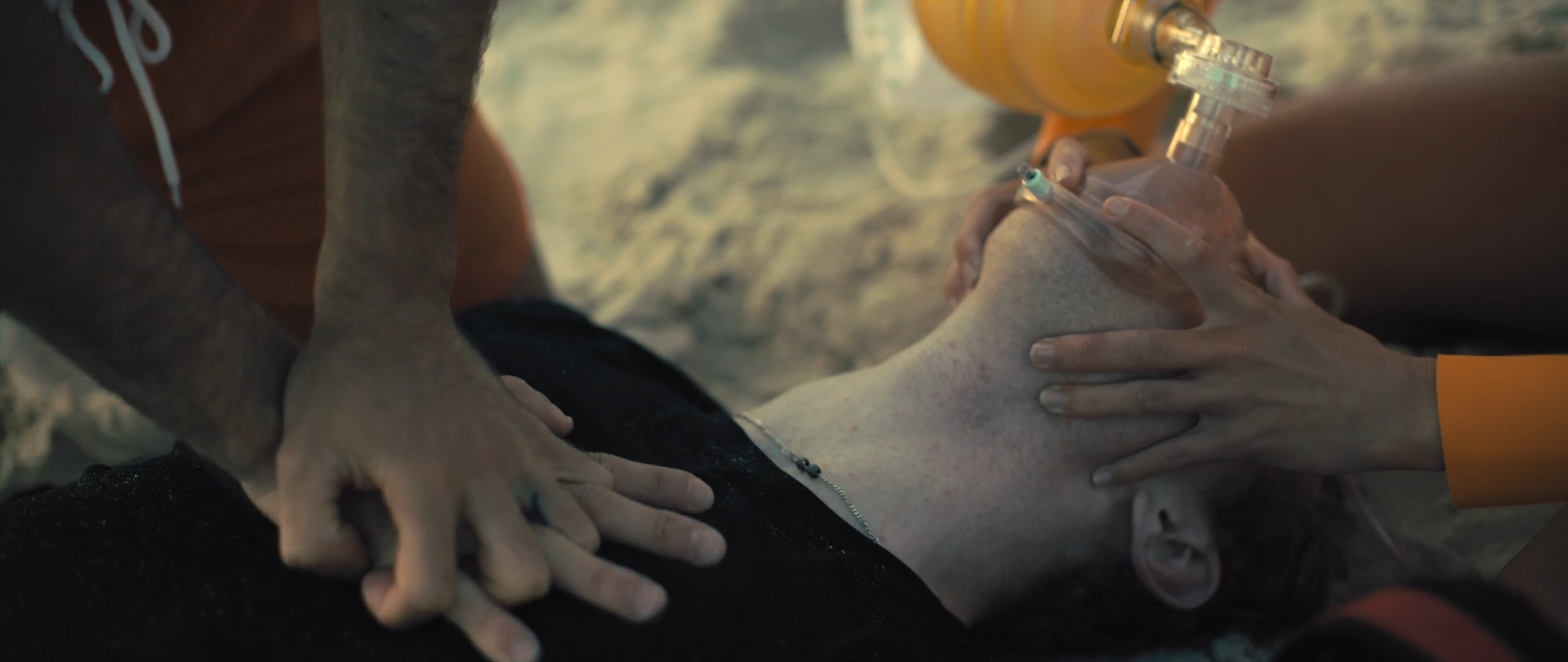
If the person is unconscious and not breathing normally, emergency help should be requested and resuscitation started immediately. The 2025 European Resuscitation Council guidelines recommend beginning with five rescue breaths and, if the person remains unresponsive and is still not breathing normally, continuing with CPR. In adults, this involves cycles of 30 chest compressions followed by two rescue breaths.
If an automated external defibrillator (AED) is available, it should be used according to its instructions after drying the person’s chest. Using it should not delay the start of resuscitation. And if the person witnessing the emergency does not know how to give rescue breaths or is unwilling to perform them, starting chest compressions is still preferable to doing nothing.
It is also important to know which actions should be avoided, such as trying to “remove the water” from the lungs by pressing on the abdomen, placing the person face down or performing manoeuvres intended to drain fluid. These actions can delay rescue breaths and chest compressions. The priority is to restore breathing and circulation.
The risk does not end once they leave the water
Not every case ends in loss of consciousness. A person may be rescued while awake but experience coughing, exhaustion, abnormal breathing or disorientation. In these circumstances, it is important to monitor how their condition develops and seek medical assistance if they experience breathing difficulties, changes in their level of consciousness or any subsequent deterioration.
If the person has a reduced level of responsiveness but is breathing normally and does not require CPR, European recommendations advise placing them on their side in the recovery position and continuing to monitor their breathing and overall condition until medical assistance arrives.
Prevention starts before entering the water
Many of the most effective measures are simple: choose supervised swimming areas, follow flags and lifeguards’ instructions and avoid places where swimming is prohibited. It is also important not to overestimate swimming ability and to avoid alcohol before entering the water. Young children require continuous, active and close supervision; knowing how to swim or using flotation aids does not replace adult supervision.
The surrounding environment is another factor to consider. Currents, waves, changes in depth or cold water, as well as a distance to shore that may initially seem manageable, can turn an ordinary swim into an emergency. The WHO has also highlighted that phenomena such as floods, storms and heatwaves are increasing certain drowning-related risks.
On 23 July 2026, the organisation presented a new technical package based on seven drowning prevention strategies. These measures include improving the safety of aquatic environments and water transport, teaching swimming and water safety skills, strengthening care for young children, providing training in rescue and resuscitation, and improving preparedness for floods and other emergencies.
The danger of expecting a movie scene
Preventing drowning, therefore, does not depend solely on knowing how to swim. It also requires understanding the environment and recognising when someone has lost control of the situation, as well as knowing how to intervene without creating an additional risk. In a crowded swimming pool or on a busy beach, an emergency can go unnoticed precisely because it does not look the way we expect it to.
A person who is drowning may not shout, raise their arms or even appear to be asking for help. They may remain silent, make no progress and focus all their energy on trying to breathe. Recognising these signs, contacting emergency services quickly and having basic knowledge of resuscitation can make the difference during a few crucial minutes when every action counts.

