


5 May 2026
Europe accelerates its technological commitment: how engineering profiles are changing
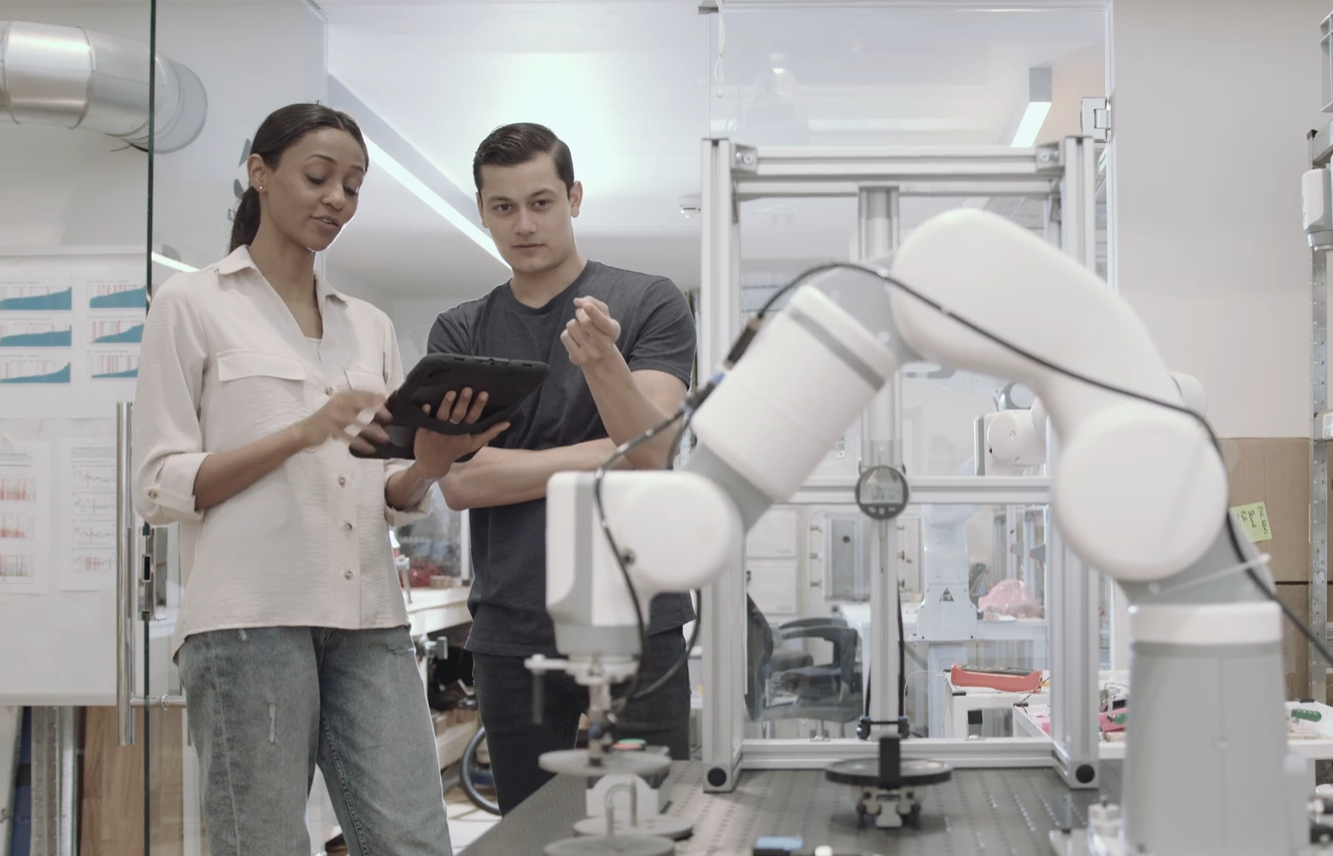
Europe has decided that it no longer wants to depend on others to manufacture its chips, its robots or its automated systems. It has the funding, it has the roadmap and it has the deadlines. But behind every new chip factory or every robot installed in a plant, there is a more uncomfortable and less headline-friendly question: who is going to design, programme, integrate and maintain all of it?
Technical talent, the real limit
The European Commission estimates that the semiconductor sector will need hundreds of thousands of qualified professionals in the coming years to achieve the European Chips Act target of doubling Europe’s share of chip production by 2030. And the European Chips Skills Academy warns of something even more structural: the supply of technical talent is growing more slowly than demand, and generational renewal is not keeping pace: more experienced engineers are retiring than new talent is entering the sector.
In other words, the bottleneck in this case is no longer funding. It is talent.
The gap between classrooms and industry
The shortage of technical profiles in Europe is nothing new. For almost a decade, we have been hearing the same thing from different sectors: there is a shortage of engineers, industrial software specialists and people capable of connecting hardware and data. What has changed is the urgency. When we talk about technological sovereignty, it is no longer a political metaphor: it means that an entire continent depends on its universities training the right people, in the right areas, on time.
And this is where the next issue appears. Industry is moving faster than study plans. By the time a graduate finishes their degree, some of the tools they used in their first year are already outdated, and part of what they will find in their first job did not even exist when they began their studies.
From research to application
SEMI Europe has recently insisted that the semiconductor ecosystem cannot be understood in isolated parts. Research, design, materials, equipment, manufacturing and advanced packaging form an interconnected chain. If one link breaks, the others stop moving forward.
The same applies to robotics. Initiatives such as Robot Hub Transfer, in the Upper Rhine region, were created precisely to support SMEs that want to incorporate automation but need help doing so realistically: studying the environment, sizing the investment, adapting processes and assessing technical and economic feasibility. It is not about buying a robot. It is about knowing where, how and why to install it.
And this is the difference: industry is no longer looking only for profiles who know things; it is looking for profiles who can apply that knowledge.
Anatomy of automation
To understand what kind of professionals are needed, it is enough to look at what can be found in a modern factory, such as a robotic cell in a bottling plant.
For that cell to work, it needs a mechanical structure with precise kinematics, capable of moving an arm within minimal margins of error. It also needs power electronics and sensors that feed motors, read positions and detect obstacles in real time. This is where Industrial Electronic Engineering comes fully into play, providing the basis for circuits, control and actuation.
It also needs a control system that coordinates sensors, actuators and movement. This is the natural territory of Mechatronics Engineering, a discipline that brings together mechanics, electronics and programming in a single training pathway designed for systems that move, detect and respond.
It also requires the overall design of the robot: architecture, integration with the rest of the line, regulations and operational safety. This is the field of Robotics Engineering, focused on making the machine useful and safe in real conditions, not only in the laboratory.
And it needs software: programmed trajectories, operator interfaces, connection with MES or ERP systems, data collection and predictive maintenance. This is the role of Computer Engineering, which turns hardware into something manageable and scalable.
What matters is not that each discipline exists separately, but that none of them works without the others. The industry of the future does not need specialists locked inside silos: it needs engineers who master their own field and, at the same time, know how to communicate with adjacent disciplines.
Education and industry, closer together
The European Commission has already taken a step in this direction. As part of the Chips Act, it has launched a network of 27 semiconductor competence centres across 24 European countries, designed as a meeting point between universities, companies and students to strengthen technical training in the sector.
The underlying intention is to break a separation that had operated by inertia for decades: universities taught theory and industry hired afterwards. That model no longer works. Both have to work together from the beginning.
This is also changing the way engineering is studied. The weight of real projects, simulations, virtual laboratories and practical cases is growing compared with purely theoretical teaching. Education is no longer measured only by what you know, but by what you know how to do.
Engineering at a decisive moment
If you are deciding what to study now, it is worth knowing that few moments have been as suitable as the current one, with such a clear alignment between what the European market needs and what it will continue to need over the next ten or fifteen years.
This is not only about employability. It is about the opportunity to enter sectors that are being defined right now, with real room to participate in how they are built, not just to occupy already established positions.
Because in the end, the conclusion brings us back to the beginning: Europe can invest billions in technology, but that investment only becomes real impact when there are people capable of taking innovation from the laboratory to the factory, from the blueprint to the product.
At Universidad Mundae, we understand engineering through that logic. Our university qualifications in Mechatronics Engineering, Robotics Engineering, Industrial Electronic Engineering and Computer Engineering are designed to train professionals who master the technical foundations and, above all, know how to apply them. Practical training, connected to the reality of industry and compatible with the personal and working lives of those who are already active professionally or want to redirect their career towards the technological sectors of the future.

