


3 June 2001
Five questions worth asking before choosing a university after the PAU
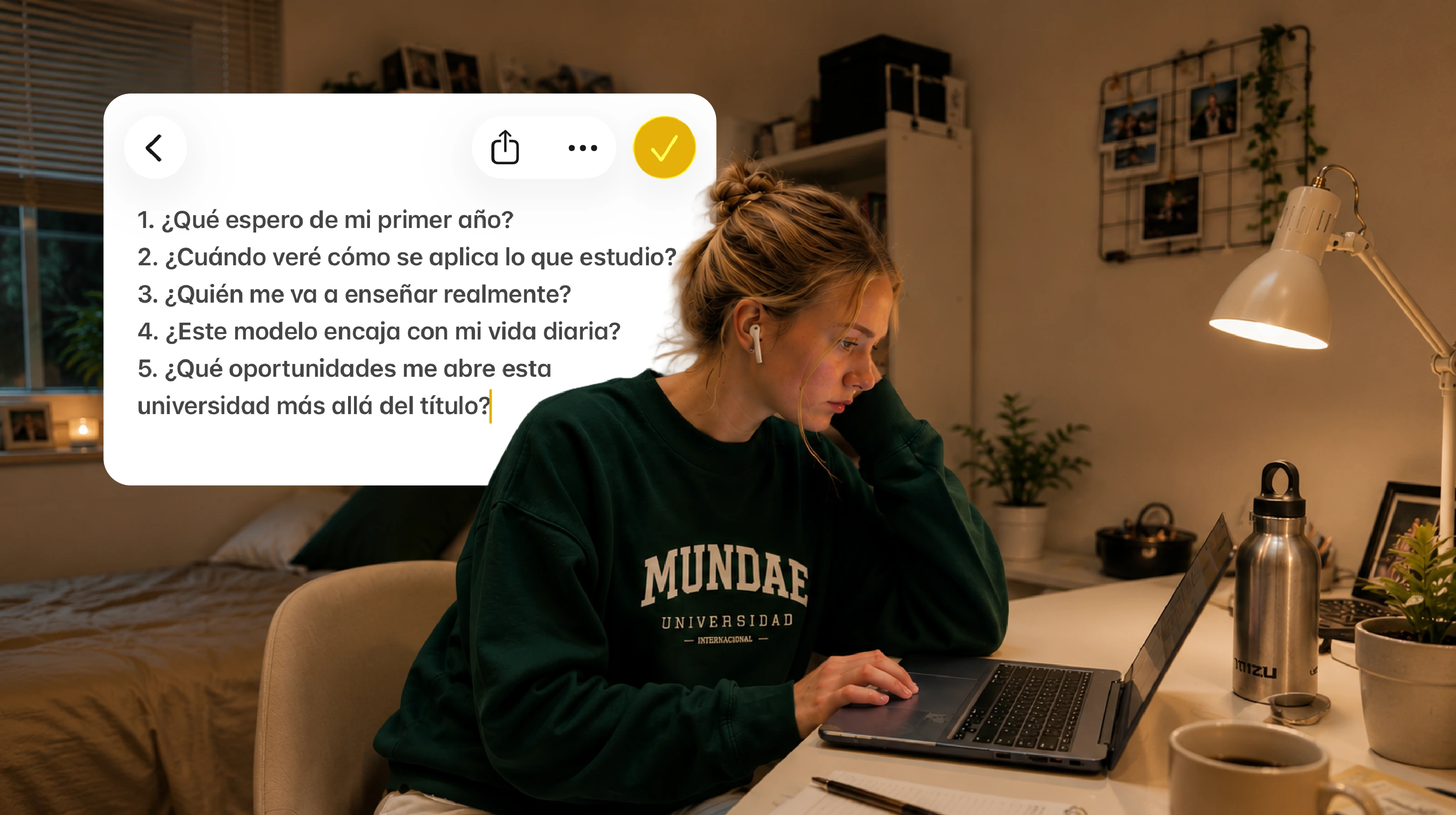
Finishing the PAU does not always bring the relief many students expect. For months, everything seems to focus on one clear goal: getting to the exams, doing as well as possible and waiting for the score. But once you have it, that is when the truly important question appears. It is no longer just about passing. It is about choosing where and how to begin a stage that will shape the way you learn, grow and enter the professional world.
At that point, it is normal for attention to shift towards what seems most visible: the degree, the cut-off score, the city, the university’s reputation or what other people recommend. All of that matters, but you decide whether to make it decisive. Two universities may offer the same qualification and yet provide completely different experiences. The difference is not only in the name of the degree, but in the learning model, the guidance, the connection with practice, the flexibility and the way each student is supported throughout the journey.
That is why, after the PAU, choosing a university should not be reduced to a single question: “where can I get in?”. Choosing well means looking a little further and asking questions that help you make a decision with solid reasoning, but above all, with honesty towards yourself. At Universidad Mundae, we suggest some of them:
1. What do I need to happen during my first year?
The first year of university is not just the beginning of a degree; it is a stage of transition. Your pace of life changes, as do the demands, the way you study and the responsibility you take for your own learning. Many students arrive with good grades, but without having fully developed autonomy, method or confidence to move within a university environment.
That is why, before choosing, it is worth paying attention to the type of support the university offers during that transition. Is there a clear and accessible tutoring figure? Are the groups small or overcrowded? Are there systems in place to detect difficulties before they turn into dropout? Is it explicitly understood that the move from high school to university is difficult for almost everyone, and is the first year designed with that in mind?
This information rarely appears in brochures, but it exists if you look for it: by talking to students who are already there, asking during open days what happens when someone needs help, and checking whether professors respond when students contact them.
At Universidad Mundae, this first-year support is an explicit part of the model, especially in health sciences degrees, where the level of demand from the first year makes support during this transition stage decisive for the student’s academic path.
2. When will I see how what I study is applied?
One of the major differences between a motivating university experience and one in which students end up disconnecting from their studies lies in the relationship between theory and reality. Some students lose interest not because they dislike the degree, but because it takes too long for them to see value and meaning in what they are learning.
This does not mean that everything has to be practical from day one, nor that theory is secondary. Quite the opposite: a strong university education needs both scientific foundations and critical thinking. But when students experience how that knowledge is applied from the beginning, they study differently. Memorising a subject is not the same as understanding how it can influence reality.
Before choosing a university, it is worth asking whether the learning model connects early with professional reality. Is there simulation? Applied case work? Progressive practical training? Contact with real environments? Is learning based only on manuals, or also on situations that require students to think, decide and communicate?
At Universidad Mundae, this connection between knowledge and practice is part of the academic approach. Education is not understood as an accumulation of isolated subjects, but as a journey in which students can begin to understand, from early stages, how what they learn becomes professional judgement.
3. Who is actually going to teach me?
One of the decisions that most affects the quality of a degree, and one that few people examine closely before choosing, is the profile of the people who will teach it. Are they researchers with little contact with the real profession, active professionals who teach part-time, or full-time lecturers trained by the university itself? Each combination creates a completely different educational experience, and in practice-based fields, that difference is noticeable from the first year.
Learning anatomy from someone who teaches it as a series of bones to memorise is not the same as learning it from someone who has operated on people and can explain why that structure matters when there is a surgical intervention involved. Nor is training in healthcare management with someone who has read about it the same as with someone who has actually managed it.
At Universidad Mundae, this idea is the foundation of the educational project: degrees are designed, led and taught by professionals from the sector itself. In health sciences, this means that the person teaching a clinical subject may still be, that same week, seeing patients or working in a hospital. The rest of the academic offer follows the same principle. Because those who teach from within the profession know how it is lived, what it demands and what truly matters.
4. Does this model fit my daily life?
After the PAU, many students imagine university as a completely separate stage from everything that came before. And, in part, it is. But real life is still there: commuting, schedules, family situation, financial resources and energy. The decision also includes, even if it seems less visible, how long it takes to get there each morning, whether moving away is necessary, whether the timetable allows you to combine studies with a part-time job, and whether the format — face-to-face, online or hybrid — fits the way you organise yourself or will make you fight against it for four years.
Few universities encourage students to make these calculations, but they are among the factors that best predict whether you will reach third year without being exhausted. A useful exercise, before choosing an institution, is to take any ordinary week of the academic year, draw up a realistic timetable with classes, commuting, breaks, study time, work —if applicable— and personal life, and see what is still standing at the end. If it is sustainable, go ahead. If not, it is worth considering alternatives before committing.
An adaptable model, it is worth clarifying, does not mean demanding less. It means recognising that each student lives, learns and organises themselves differently, and designing the degree with that idea in mind: autonomy with support, digital resources with face-to-face experiences, theory with practical application. In short, education designed to fit the student’s life, not the other way around.
5. What opportunities does this university open up beyond the qualification?
A university qualification matters. But the experience surrounding that qualification matters too. Mobility opportunities, internships, international projects, contact with professionals, agreements and academic guidance are the difference that shapes a student’s path.
That is why, before choosing a university, it is worth looking beyond the first year and asking this other question: what doors can this environment open for me over the next few years?
Not all universities offer the same relationship with the professional world. Nor do they all have the same international vision or the same ability to connect students with diverse experiences. In a sector such as healthcare, where technology, mobility and collaboration between countries carry increasing weight, training with an international outlook can be decisive.
Universidad Mundae starts from that idea: university education should not be limited to delivering content, but should create the conditions and experiences that help students build their own path. In practice, this means learning in contact with different methodologies, academic cultures and professional environments: an experience that broadens the way the profession is understood and prepares students for more complex scenarios.
Choosing a university means choosing how you want to learn
After the PAU, it is understandable to look at the score, compare options and feel some pressure to decide quickly. But we must keep in mind that a number only guides and limits access to a degree; it does not say what kind of student you are, how you learn best or what environment can help you grow. Since none of that fits into a score, choosing a degree is only one part of the decision: where you study, how you learn and what kind of support you receive also matter.
And all of that is what turns a university into much more than a place where classes are taught. It is a learning model that defines how you relate to knowledge, to your professors and to the profession you are going to practise. That is why, before deciding, it is worth pausing and looking more closely at what lies behind the name of the degree and the cut-off score.
Choosing well does not mean having all the answers. It means asking better questions before starting. And that can greatly change the way you experience university.

