


14 April 2026
NASA's AVATAR project: how organs in space can revolutionize medicine

What the NASA AVATAR Project Is and How the Artemis II Mission Studies the Human Body in Extreme Conditions
When we talk about the NASA AVATAR project, the first image that comes to mind might be science fiction. But the reality is much more fascinating: in the Artemis II mission, launched on April 1, 2026, NASA not only sent astronauts to the Moon but also miniaturized human organs capable of revealing how our body responds in space. The ultimate goal is not only to explore the universe but to transform medicine as we know it on Earth.
Behind the epic of the most ambitious space journey of recent decades, one of the most promising medical research lines of our time is taking shape: the possibility of studying the human body in conditions impossible to replicate on Earth.
Artemis II: The Return to the Moon with a Medical Purpose
The Artemis II mission is the first crewed mission to the Moon since the historic Apollo 11 in 1969. However, unlike that 20th-century space race, the current goal is not just to arrive but to understand what happens to the human body when it moves away from Earth's protection.
By venturing into deep space, astronauts leave Earth's magnetic shield and are exposed to a radically different environment, key to studying the effects of radiation on the human body and how microgravity affects health. Specifically, the body faces two major challenges:
• Galactic cosmic radiation, much more intense and penetrating than any radiation on Earth.
• Prolonged microgravity, which alters fundamental biological functions such as bone mass, blood circulation, and cell regeneration.
These extreme conditions not only pose a risk to astronauts but offer an unprecedented scientific opportunity: to observe how the human body reacts when pushed to the absolute limit.
What the NASA AVATAR Project Is and How Organs Work in Space
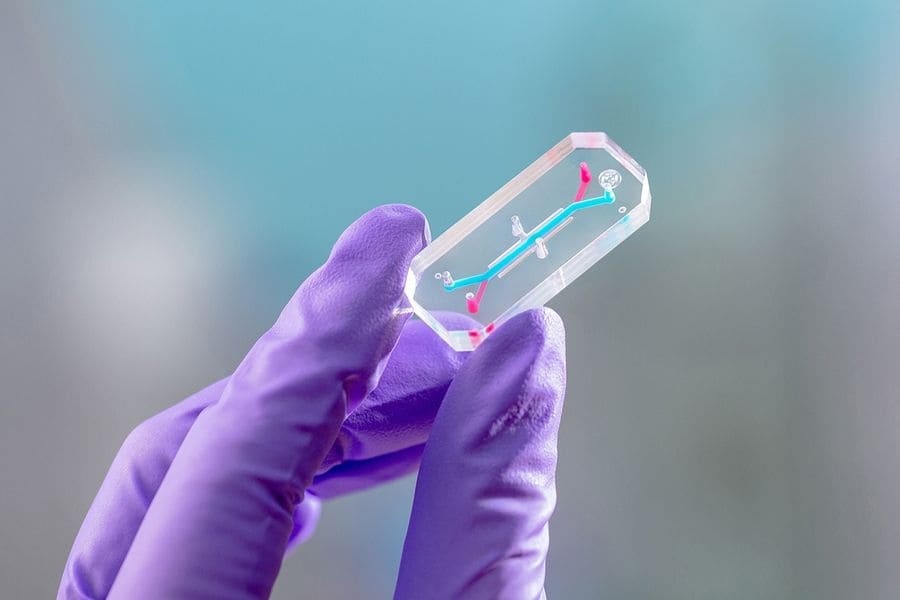
Image: NASA / Artemis II Mission Team
The NASA AVATAR project (A Virtual Astronaut Tissue Analog Response) is one of the most innovative and ambitious experiments included in the Artemis II mission. Its operation seems taken from science fiction, but it is real science: it consists of sending miniaturized biological structures to space, human organs reduced to the size of a USB device.
What makes the NASA AVATAR project truly revolutionary is that these systems are not artificial models. They are built from living stem cells, specific to each of the mission's astronauts. In other words, each astronaut also travels through their own cells, replicated in the laboratory.
These miniature organs are designed to mimic essential functions of the human body:
• They can beat like a heart.
• They can breathe like a lung.
• They can metabolize like a liver.
They are not complete organs but functional biological systems that reproduce the basic responses of each tissue. This allows scientists to observe, in real time, how real human tissues react under extreme space conditions without directly risking the astronaut's health.
Bone Marrow: The Tissue Most Vulnerable to Space Radiation
One of the main focuses of the NASA AVATAR project is bone marrow, a tissue fundamental to life and one of the most sensitive to radiation. It is the core of the body's hematopoietic and immune system, responsible for producing:
• Red blood cells, responsible for transporting oxygen.
• White blood cells, essential for the immune system.
• Platelets, key in blood clotting.
Precisely because of its high sensitivity to radiation, bone marrow becomes a critical indicator for understanding how extreme environments affect human biology. And the relevant part is that this knowledge does not stay in space: it has direct applications in terrestrial medicine.
From the Moon to Hospitals: Real Medical Applications of the NASA AVATAR Project
Although it may seem like an experiment focused exclusively on space exploration, the impact of the NASA AVATAR project goes far beyond. One of its main objectives is to improve our understanding of how radiation affects human tissues, something directly applicable to medical treatments against cancer, such as:
• Radiotherapy.
• Chemotherapy.
• Other treatments that affect high-regeneration cells.
Currently, one of the major problems in oncology is that treatments against tumors also damage healthy tissues, especially bone marrow, causing side effects such as anemia, immunosuppression, or extreme fatigue. Thanks to studies like AVATAR, scientists could analyze more precisely how radiation destroys tumor cells, identify damage thresholds in healthy tissues, and design more selective and less aggressive treatments.
This opens the door to precision medicine where the goal is not only to destroy cancer but to do so minimizing collateral damage to the body.
A New Era of Space Medicine Applied to Earth
The combination of Artemis II and the NASA AVATAR project represents a paradigm shift in biomedical research. For the first time, space is not just a destination for exploration but a natural laboratory where human biology is studied under conditions impossible to replicate on Earth.
Microgravity and cosmic radiation act as a biological accelerator, revealing processes that on Earth would take years or decades to manifest. This allows researchers to observe accelerated cellular aging, study tissue degradation in real time, and evaluate the resilience of complete biological systems, all with a clear final goal: to improve human health on our planet.
Frequently Asked Questions about the NASA AVATAR Project
What exactly is the NASA AVATAR project?
The NASA AVATAR project (A Virtual Astronaut Tissue Analog Response) is a scientific experiment included in the Artemis II mission that consists of sending miniaturized human organs to space, built from living stem cells of the astronauts themselves, to study how the human body responds to space radiation and microgravity.How does the AVATAR project benefit cancer patients?
The data obtained in space about how radiation affects bone marrow and other tissues can help design more precise oncological treatments, such as radiotherapies that destroy tumors with less damage to surrounding healthy tissues.When was the Artemis II mission launched?
The Artemis II mission was launched on April 1, 2026. It is NASA's first crewed mission to the Moon since Apollo 11 in 1969.Are the organs traveling in space real?
Yes. Although miniaturized, the organs in the AVATAR project are built from living stem cells of the astronauts, so they are functional biological systems capable of beating, breathing, and metabolizing, not artificial models or mock-ups.
Conclusion: When Space Becomes Medicine
Artemis II is not just a return to the Moon. And the NASA AVATAR project is not just a space experiment. Together they represent a new way of understanding the human body: leveraging the universe's most extreme conditions to solve some of the greatest medical challenges of our time.
Understanding the human body in space can paradoxically be the key to healing it better on Earth. And that frontier between space science and medicine has just begun to blur.

