


26 May 2026
The organ that never fully sleeps: what the brain hears under anesthesia
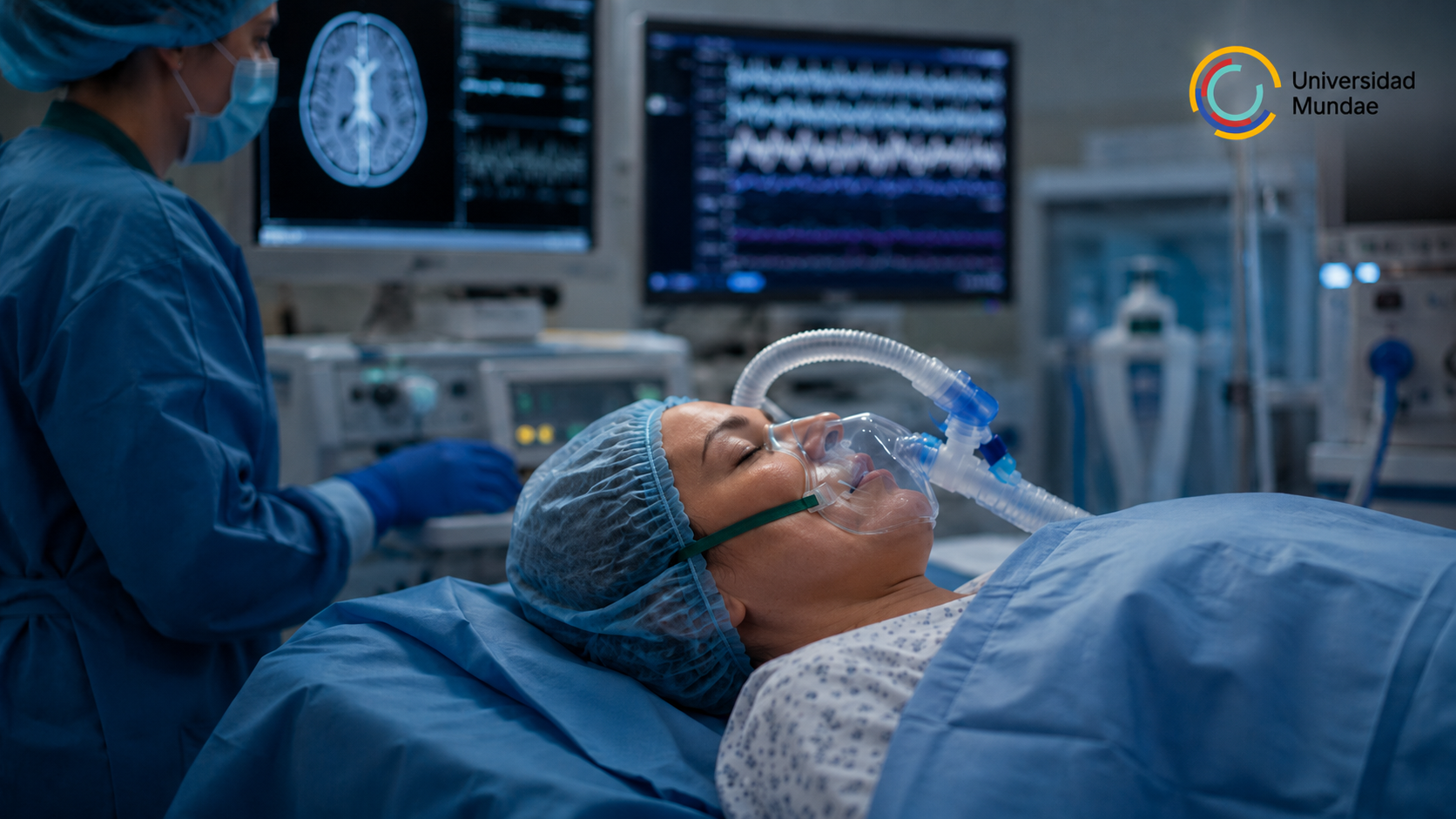
A person enters the operating room, receives general anaesthesia and, from the outside, appears to disconnect from the world. They do not respond, do not move, do not remember. For the patient, between "we’re going to begin" and waking up in the recovery room, there is usually a blank space. But for the brain, that interval may not be as quiet as we imagine.
For a long time, general anaesthesia has been explained in simple terms: a kind of deep sleep induced by drugs. The comparison helps us understand it, but it is not exact. Under anaesthesia, the brain does not simply enter "rest mode". Consciousness is altered, the response to pain is blocked, the ability to react to the environment is reduced and the experience is prevented from being stored as a conscious memory. But that does not mean all brain activity disappears.
Research published in Nature in May 2026 has reopened this question from a fascinating perspective: can the brain continue processing sounds, words or even fragments of language when a person is under general anaesthesia? The study recorded neuronal activity in the hippocampus of anaesthetised patients using high-density microelectrodes and observed responses to tones, natural language and unexpected sound patterns. The question it raises, however, is not only whether the brain "hears", but what exactly hearing means.
The difference between sleeping and being anaesthetised
General anaesthesia is not the same as closing your eyes and resting. It is a controlled pharmacological state in which several effects are sought at the same time: unconsciousness, analgesia, immobility and amnesia. That is why it is so useful in surgery, but also so interesting for neuroscience. It allows us to observe what happens when the brain stops generating a conscious experience, while still maintaining electrical activity, sensory responses and a certain internal organisation.
The difference matters. During sleep, the brain moves through stages, produces dreams and can respond to stimuli in variable ways. Under general anaesthesia, drugs profoundly modify communication between brain regions. They do not only reduce the activation of certain areas; they also alter how those areas coordinate with one another.
A study discussed by MIT in 2024 explained it with a very clear idea: under propofol, a sensory region can continue detecting simple sounds, but communication with frontal areas, which are necessary to interpret information and make decisions, is interrupted. In other words, the signal can enter, but it cannot advance to the level at which it becomes conscious perception.
The brain reads, even if it does not listen
The Nature study focused on the hippocampus, a region best known for its role in memory, learning and the organisation of experience. It is not the first area we would think of when talking about hearing, and that is precisely why the finding is striking. If even a structure far from the primary sensory areas retains some response to auditory stimuli, the idea of a completely "switched-off" brain is insufficient.
The researchers presented anaesthetised patients with sequences of tones and fragments of language. In some cases, the brain detected unexpected sounds within a repetitive series. In others, neuronal signals contained information related to semantic and grammatical features of speech. They even observed signs of prediction about future words, something the brain constantly does when we are awake: anticipating what comes next in order to better interpret what it hears.
This does not mean that the person is "hearing" the operating-room conversation consciously. The key difference is processing. Something similar happens in many everyday situations, although on a very different scale: we filter background sounds, react to our name in someone else’s conversation or perceive changes in the environment before thinking about them explicitly.
Anaesthesia takes that separation to a clinical and scientific extreme. It allows us to distinguish between three levels that we usually mix together: the brain receiving a signal, the person being aware of it and later being able to remember it.
Activity does not imply consciousness
This is perhaps the most important part. When we talk about anaesthesia, the question should not only be "does the brain hear?", but "what does it mean to hear?" One thing is for a neuron to respond to a sound. Another is for the patient to have a conscious experience. And another, quite different, is for them to be able to describe what happened after waking up.
Explicit memory, the kind that allows someone to say "I remember this", depends on processes that can be blocked during anaesthesia. That is why a brain signal does not automatically equal a memory. In the Nature study, patients did not report explicit memories of intraoperative events, even though their neuronal recordings showed activity linked to the stimuli presented.
This nuance is essential to avoid alarmist interpretations. The study does not imply that patients are awake without knowing it. Accidental intraoperative awareness does exist, but it is an uncommon complication and different from unconscious brain processing. The NAP5 report by the Royal College of Anaesthetists estimated an approximate incidence of one reported case per 19,000 general anaesthetics, although this varies depending on the clinical context.
What recent research suggests is something else: the boundary between brain activity and consciousness is more complex than it seemed. The brain can retain partial capacities for analysis, learning or prediction without that meaning the person is awake, suffering or remembering the procedure.
When the patient does not speak but still informs
This may seem relevant only from a purely neuroscientific perspective, but it has a specific clinical reading. If certain regions continue registering stimuli under anaesthesia, even without forming conscious experience, the operating-room environment is no longer irrelevant to the patient, at least at a physiological level. That does not mean every conversation is recorded in their memory: speaking of "hidden memories" would be a disproportionate interpretation. But it does nuance a very common image: that of the sleeping body to which nothing reaches anymore.
For healthcare teams, this nuance does not introduce new protocols, but it reinforces an already standardised practice: treating the anaesthetised patient as a patient, not as a body on pause. Communication between professionals, careful handling, attention to comfort and continuous monitoring are no longer read as simple technical courtesy, but as part of active care.
This nuance is directly reflected in the work of operating-room nursing. A large part of this work consists of monitoring, in real time, the signs that reveal what the anaesthetised patient may still be processing: variations in heart rate or blood pressure in response to a stimulus, micro-responses that may indicate insufficient anaesthetic depth, and specific parameters such as the bispectral index (BIS), a monitoring tool for level of consciousness incorporated into practice precisely because the boundary between being conscious and not being conscious is not binary. In the immediate postoperative period, nursing observation is also key to detecting signs compatible with intraoperative awareness, the uncommon complication described in reports such as the NAP5 mentioned above. More than technical support, nursing acts as a clinical eye that translates the activity of the anaesthetised brain into useful information for the rest of the team.
A scientific window into consciousness
General anaesthesia is a clinical tool, but also a scientific window. It allows us to study what the brain needs for consciousness to exist. Current studies suggest that it is not enough for a region to activate: for an experience to be felt as one’s own, there seems to need to be a specific coordination between sensory, cognitive and memory areas. Consciousness, therefore, would not be a switch that turns on or off, but the result of an internal conversation that can be interrupted at different levels.
That is the paradox that makes this topic so interesting: under anaesthesia, the brain is not awake, but it is not empty either. It can detect, classify and anticipate.
For those training in health sciences, this type of evidence is valuable for one specific reason: it shows that what a patient does not express can also be clinically relevant information. At Universidad Mundae, Nursing training is oriented towards developing that reading of the patient, attentive to processes before, during and after each intervention.
Because one of the most important lessons we can draw from this research is that, even in silence, the brain is still saying something.

