


16 June 2026
Beyond a single ultrasound scan: the patch that could transform high-risk pregnancy monitoring
Reading time5 minutes
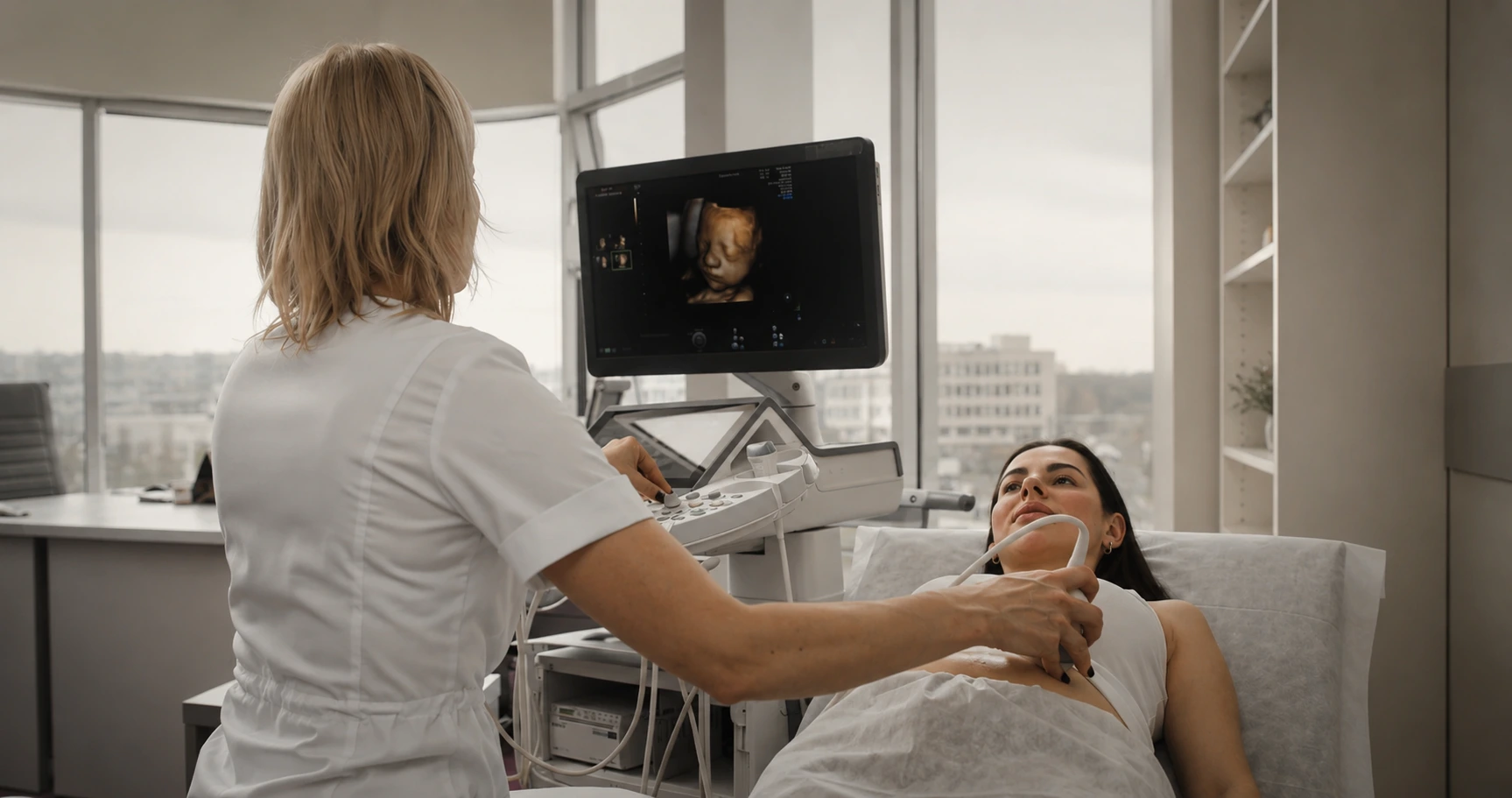
An ultrasound scan makes it possible to **assess how the fetus is developing**, evaluate its growth and obtain information about **blood circulation**. However, each examination only provides an image of what is happening at the specific moment when the check-up takes place. In an uncomplicated pregnancy, that snapshot is usually sufficient, but when **preeclampsia, hypertension, placental insufficiency or fetal growth restriction** are present, changes may require **much closer observation**.

An international group of researchers has developed **UPatch** specifically for these higher-risk cases. This adhesive ultrasound device is designed to record, over several hours, **some of the signals usually assessed through Doppler ultrasound**. The study, published in May 2026 in **Nature Biotechnology**, raises the possibility of complementing conventional check-ups with **longer observation that depends less on isolated measurements**.

The development is still **at an experimental stage**. Even so, the initial results indicate that **wearable technology could transform the monitoring** of higher-risk pregnancies and provide healthcare professionals with **a more complete picture of their progression**.


## What a single ultrasound scan may miss

In certain pregnancies, one of the main objectives is to determine whether **the placenta is functioning correctly**. This organ enables **the exchange of oxygen and nutrients** between the mother and the fetus. When this process is disrupted, **growth may be affected** and **the likelihood of complications increases**.

Doppler ultrasound helps analyse **how blood flows through the umbilical cord** and other relevant vessels. Its results can reveal **signs of abnormal resistance** or an insufficient blood supply. The limitation is that the examination is conducted **over a short period of time** and requires **the involvement of specialised professionals**.

This means that **a normal measurement has certain limitations**, as it does not necessarily reflect what may happen, for example, during the following hours. Some abnormalities **occur intermittently**, develop gradually or go unnoticed during a single examination. Having **a longer recording period** could help distinguish a temporary variation from **a persistent pattern requiring immediate assessment**.

This information is particularly important when the medical team must decide whether to **prolong the pregnancy or deliver the baby early**. An early intervention may involve **risks associated with prematurity**, while waiting too long when there is **placental deterioration** could also compromise **fetal well-being**.


## More hours of information

**UPatch was developed in response to this margin of uncertainty**. The device is **approximately the size of the palm of a hand** and adheres to the pregnant woman’s abdomen. Its purpose is to **capture images and analyse blood flow** without requiring a specialist to hold the transducer manually throughout **the entire examination**.

The system focuses on **an area of the umbilical cord close to the placenta**, which tends to remain more stable despite **fetal movements** or changes in the mother’s position. It also incorporates **computer software** that helps identify the relevant structures and **maintain the signal for longer periods**.

The main innovation lies not in replacing existing tests, but in **extending the observation window**. Instead of providing only a few minutes of information, the adhesive device can capture **a sufficiently long sequence** to identify **trends, fluctuations or changes** that a brief examination might not reveal.

It can also calculate **some of the parameters commonly used to assess fetal development**. However, its most relevant potential concerns **placental and umbilical circulation**, as it offers the possibility of **examining them continuously** over several hours.


## 62 pregnant participants and up to 6 hours of recording in the first study

The researchers tested **the prototype in 62 pregnant participants** and compared its measurements with those obtained using **conventional clinical equipment and techniques**. The results showed **good agreement across the indicators analysed**, suggesting that the device can provide data similar to those obtained through **a Doppler ultrasound performed by a professional**.

In one part of the study, **52 participants used the system** for periods of **between one and six hours**. The group included uncomplicated pregnancies as well as others associated with **preeclampsia, hypertension or diabetes**, in addition to cases involving **fetal growth abnormalities**.

Another advantage identified during the research was that **the adhesive device maintained the recording** while the women were sitting, moving or changing position. This capacity is important because **signal loss** is one of **the main difficulties** associated with **obstetric monitoring devices**.

One of the cases described also demonstrated **the potential value of extending the observation period**. A participant at 28 weeks initially presented **a fetal heart rate within the expected range**. However, the prolonged recording detected **significant variations in blood flow through the umbilical cord**. Subsequent tests confirmed a severe placental abnormality, and the medical team intensified monitoring before performing **a caesarean section several days later**.

This case illustrates **the type of information the tool could provide**, although it does not yet demonstrate on its own that it **improves clinical outcomes**. Establishing that benefit will require **larger studies** comparing the progression of patients monitored with this system with those who receive **standard care alone**.


## The next step: bringing monitoring into the home

Aware of these limitations, the researchers have proposed **its initial use within hospital settings**. In units specialising in **high-risk pregnancies**, the device could complement periodic examinations and provide **a broader view of fetoplacental circulation**.

It could also reduce **the need to reposition sensors constantly**, a common task when the fetus moves or changes position. Healthcare professionals would continue **interpreting the results and making clinical decisions**, while automation would facilitate **the continuous collection of information**.

In the longer term, the researchers are studying **a wireless version** that could be used outside the hospital. This possibility would allow certain situations to be monitored **from home** or from centres with fewer specialised resources, always within **a clearly defined care protocol**.

For women who live far from **an obstetric unit** or need to travel frequently for check-ups, **this form of remote monitoring could be particularly valuable**. Even so, bringing the technology into the home raises **technical, logistical and clinical challenges** that **have yet to be resolved**.


## More information also requires better judgement

Recording for several hours generates **a much larger volume of data** than a conventional examination. This abundance may be useful, but only when there are **clear criteria for interpreting it**. A variation does not always indicate a problem, and turning every change into an alert could increase **unnecessary interventions** or cause **anxiety**.

Future studies will need to determine **which patterns genuinely predict a complication** and which are part of **normal variability**. They will also need to define **the thresholds that require a review**, an additional test or **medical intervention**.


## From a promising advance to clinical practice

For education in the Health Sciences, this type of innovation also reflects **a broader transformation**. Obstetrics, biomedical engineering, image analysis and data processing are becoming **increasingly interconnected**. At Universidad Mundae, bringing these advances into the learning environment makes it possible to understand both **their potential** and **the conditions required to apply them rigorously**.

If further research confirms its usefulness, this technology could add **a new layer of information** to the monitoring of **the most complex pregnancies**. The change would not involve replacing medical check-ups, but rather **reducing some of the gaps in information** that exist between **one examination and the next**.

